Sundman figures it out! is an autobiographical meditation, in the spirit of Michel de Montaigne, of a 7172 73 year old guy who lives with his wife in a falling-down house on a dirt road on the island of Noepe, also known as Martha’s Vineyard, that dead-ends into a nature preserve.
Incidents, preoccupations, themes and hobbyhorses appear, fade, reappear and ramify at irregular intervals. If you like this essay I suggest checking out a few from the archives. These things are all interconnected.
Sundman figures it out! is a reader-supported publication. To receive new posts and support my work, consider becoming a free or paid subscriber.
Précis
I am trying to decide whether I should attend the 2026 DEF CON hacker’s convention, set to take place in Las Vegas, August 6 - 9.
If I decide that I should attend, the next questions becomes whether I can assemble enough cash to go, and how can I make sure things on the home front are safe & secure while I’m away.
In this post I talk about such things.
DEF CON — A guide for the perplexed
Here’s the first paragraph from the Wikipedia entry for DEF CON:
DEF CON (also written as DEFCON, Defcon, or DC) is a hacker convention held annually in Las Vegas, Nevada. The first DEF CON took place in June 1993 and today many attendees at DEF CON include computer security professionals, journalists, lawyers, federal government employees, security researchers, students, and hackers with a general interest in software, computer architecture, hardware modification, conference badges, and anything else that can be “hacked”. The event consists of several tracks of speakers about computer and hacking-related subjects, as well as cyber-security challenges and competitions (known as hacking wargames). Contests held during the event are extremely varied and can range from creating the longest Wi-Fi connection to finding the most effective way to cool a beer in the Nevada heat.
I’ve attended DEF CON twice — in 2010 and in 2016. Both times I hung out almost entirely in the vendor room, where I sold my hackertastic self-published novels. In 2016 I also took a short break to give a 10 minute talk, “Ethical Challenges & Responsibilities of Biohackers and Artists,” in the inaugural ‘biohacking village’.
Here’s how I described DEF CON in a post on my currently dormant website Wetmachine in 2010, after the first time I attended the event:
DEF CON is an annual tribal convocation of black-hat hackers, crackers & criminals & their white hat adversaries — along with associated geeks, grey hats, poseurs, script-kiddies, Feds, and corporatist & statist agents of control that takes place every summer in Las Vegas. It’s the largest such gathering in the world. 2010 was Defcon #18.
[To ensure anonymity], admission is cash-only. There’s no pre-registration for Defcon & no attendance list. So projecting how many people are going to show up is a guessing game. This year, going in, the organizers expected between five and ten thousand people to show up.
Since I wrote my 2010 Wetmachine essay a few things have changed. It’s now possible to pre-register, for example. But as far as I can tell from the DEF CON website, the vibe of the annual conclave remains pretty much the same.
If I do attend DEF CON this year it will be as an observer only, not as a bookseller or program participant. Further below I’ll have a bit more to say about why I’m considering going this year. But first, a little disquisition on the existential meaning of hacking, which I copy/pasted from my essay, A chronicler of biodigital technopotheosis: How I accidentally became a self-publishing cyber-bio-nanopunk novelist& then lightly edited. (BTW if you’d like to know a bit more about my books, that post is probably the best place to start. It contains brief summaries & origin stories for all of them.)
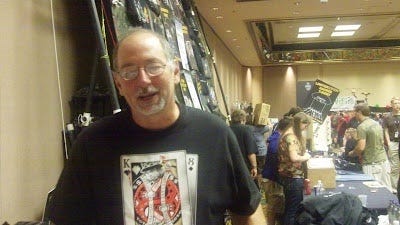
I traded a copy of my hackertastic nano-bio-cyberpunk novel Acts of the Apostles for this t-shirt. There are two kings on the playing card. Not visible, upside down at the bottom of the card is the White Hat king, blowing a whistle. The Black Hat king, on top, ignoring the White Hat, holds a bloody axe in his hand.
The above photo was taken by the Argentine novelist, journalist, librettist and translator Pola Oloixarac, from her photo-blog account of DEF CON 18 in 2010. It’s in Spanish, but you can probably follow it. And the photos don’t require any translation.
The existential meaning of hacking
More than thirty years ago I set out to write a simple murder mystery but ended up spending four years creating a whole new imaginary branch of ‘bio-digital’ science just to solve a plot problem.
I’ve now written four novel(la)s, in various styles and formats, and they all deal with two phenomena: (1) the convergence of biological and digital technologies, and (2) hacking
My own background is more on the digital side of things than the biological, but I married molecular geneticist and I was, and am, amazed by everything she did in her various laboratories. Starting within days after I met this woman I made a hobby of studying molecular biology from the point of view of a fascinated ignoramus. Because you can damn well believe I was fascinated.
With my sterling background of one undergraduate survey course in biology — taken six years before I met the molecular geneticist in question — I began attending advanced lectures on topics like shifted reading frames and overlapping gene products in single-stranded DNA bacteriophage (viruses that prey on bacteria). I was in way over my head and only understood half of what I heard or read, but yet I did over time manage to learn a lot. And the more I learned, the more I came to think of biology in terms of systems — cells as systems, microbes as systems, organelles as systems, complex organisms like people as systems. . . The more I learned about biological systems, the more I saw similarities between them and the digital systems I was more used to working with. Which made me think of hackers.
Hackers look at complex systems as challenges; they are things to be broken into and manipulated for personal gain, or for political reasons, or to fix things that are broken, or for bragging rights, or, perhaps mainly, for fun; which is to say, hackers hack in order to learn how systems work and to manipulate those systems — just as any healthy 10 month old child delights in manipulating a simple toy. By playing, the child learns — about the toy, about their bodies, about their world, and about the pure joy of control. Many hackers hack for the same simple reason: it’s fun.
The Soul of a New Machine, a nonfiction book by Tracy Kidder, conveyed to general readers some of the joy of designing computer systems. In books like Snow Crash and Neuromancer, Neal Stephenson and William Gibson, among others, created a new genre of science fiction that came to be called ‘cyberpunk,’ that was about the joy of hacking those systems. Breaking into them. Taking control of them.
About the same time as Snowcrash and Neuromancer, although at first not quite as noticed, another new subgenre of science fiction was emerging: biopunk.
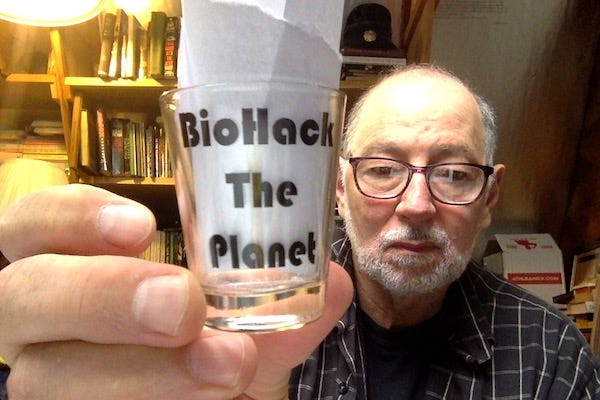
When biohacker Josie Zaynor live-streamed herself injected a CRISPR cocktail in an attempt to edit her own genome at the SynbioBeta conference in 2017 it was front-page news around the world. But there were only about 30 of us witnesses in the room to see it first hand —some of us sipping whiskey from the shot glasses Zaynor provided.
If ‘cyberpunk’ is the genre that looks at digital systems from a hacker’s point of view, then ‘biopunk’ looks at biological systems from a hacker’s point of view.
Most non-biohacker/biopunk people make a distinction between, for example, living, carbon-based biological systems on one hand and silicon-based digital systems on the other. Biopunks don’t make that distinction. A system is just a system, and the only question is, how do you hack it?
Now if the system is, for example, you — your brain, your mind, your essence, your soul — you may like it just fine the way it is, thank you very much, and you may not want somebody else (where “somebody” might be “the government” or some squicky corporation) to hack it. So your challenge becomes, How do I define who I am? How do I maintain the integrity of my system?
All my novels deal with themes like these. In Acts of the Apostles, among other things, I imagined nanomachines analogous to bacteriophage that manipulate DNA and rearrange brains (and by rearranging brains, thus minds, and selves). In a lot of ways in Acts of the Apostles I anticipated CRISPR, the powerful new way of programming DNA that emerged about a decade ago. The plot of my novel revolves around how such a mechanism might work on the molecular level, and invites readers to ponder the ethical considerations that come with it.
As someone whose income, to a considerable extent, comes from writing about the convergence of biological and digital technologies, and the hacking, not to mention the social & ethical implications thereof, whether in the form of novels or substack posts or whatever, I try to keep my finger, however lightly, on the pulse of developments in the realm of biodigtal technopotheosis.
Are you ready to ascend? Illustration for In Formation magazine by Troy Dunham
Editing your own genome, transhumanism, eugenics, centuries-long lifetimes, brain implants and digital souls, robotheism, new-age cults and neo-techno-Christianity. . . Things that use to only exist in science fiction now shape the philosophies and day-to-day activities of some the most wealthy, technologically sophisticated and powerful people on earth. And you can bet these ideas will hover over DEF CON like white-hat angels and black-hat demons.
My mother always said that sharing Sundman figures it out! was as easy as writing an off-by-one buffer-overflow exploit for a reflecting-pool algae filter.
SynbioBeta is one of, or perhaps the, premier conference(s) for people in the field of what used to be called ‘synthetic biology,’ but which, every day, is becoming more synonymous with ‘biology,’ plain and simple.
Since sometime around 2012 I’ve attended many SynbioBeta events, In the USA and in Scotland, as bookseller, observer, program participant and journalist. In its early days, SynbioBeta embraced biohackers, academics, and people from the corporate world. Over the years it has tended towards almost exclusively focusing on corporate science.
As I wrote in my (January, 2026) essay A synthesized synthetic biology reporter: Regarding my press pass for SynBioBeta 2026, after the annual SynbioBeta conference held in May, 2025, at which I was dismayed by what I can only call the cowardice of the organizers and program participants in light of the ongoing attack on science in the USA, I decided that I could no longer be a participant in SynbioBeta events.
But, given the prominence that SynbioBeta has attained, I thought it was important that the event be reported on, and so I requested, and was given a press pass for the 2026 event. Unfortunately, for personal reasons I was not able to attend. And it seems to me that virtual finger no longer feels the logical biodigital pulse.
These two essays, which I wrote shortly after returning home from the SynbioBeta 2025 conference, capture my disappointment and concern:
An image from a vendor’s booth at SynbioBeta 2025 shows a virtual reality system for inspecting an manipulating molecules that appear to float in the air in front of you. I invented a nearly identical system as a thought experiment for my 1999 novel Acts of the Apostles.
So as documented & lamented in the aforementioned essays, SynbioBeta has made a deliberate and concerted turn to the corporate world, casting its lot with the oligarchs, leaving its erstwhile traveling mates the biohackers behind. So how am I to get my finger back on the pulse?
If you’ve read any of the preceding, I expect that you can understand why I’d like to go to (what the English author Will Storr calls ‘the world’s most grotesque city’) Las Vegas, in the heat of summer, for DEF CON 34, three short weeks from now, without me spelling it out for you. But here, let me spell it out:
I want to go to DEF CON this year to see what the vibe is like in hacker reality. In digital space, what’s the buzz around things like Palantir and governmental pan-surveillance and technofascism and personal autonomy and resistance? In bio space, what’s the buzz on security and the integrity of science and self-modification and longevity, extropianism, transhumanism and quasi-religious hacker woo-woo? And what’s the state of the bio-digital convergence?
And of course we can expect the specter of AI, AI, AI to be everywhere in the halls.
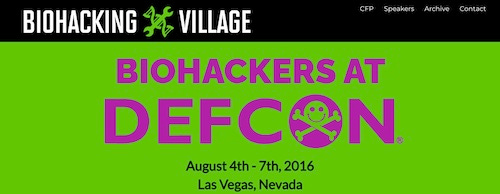
The first time biohacking had its own theme ‘village’ at DEFCON was in 2016, and I gave a talk at it. I hope I get some cred for that?
Abstract from my 2016 DEF CON talk, which was based on the talk I gave to close a SynbioBeta at the University of Edinburgh earlier that year:
The convergence of biological and digital technologies is one of the most significant aspects of the world we inhabit -- perhaps *the* most significant, since from this convergence we can plausibly extrapolate to near futures featuring everything from the elimination of poverty, want and death to the end of life on earth. This trend has been evident for a while, but CRISPR puts it in our faces.
Unlike, say, nuclear technology, biodigital technology is inherently democratic. We are in a biohacking maker world, and we're not going back.
The positive uses for these technologies are limitless, and many of them easy to imagine. The dangers are a little less obvious, but many of them can be anticipated, and there are certain to be unanticipated dangers as well. The potential for societal disruption, among others, has been widely underestimated.
What ethical responsibilities do biohackers and scientists bear? And do artists and intellectuals, writers in particular, have an obligation to take on these subjects, maybe even provide some guidance?
These questions from ten years ago still interest me, but frankly I’m just as interested these days in observing and reporting.
Logistics
As I said at the top, I’m trying to decide whether I should attend DEF CON 34 in Las Vegas this year. In this post I’ve given a sketch of why I want to go, but that doesn’t mean I should go. I have personal reasons for not wanting to be far from home. They may keep me here. I’ve got to figure that out. I’m giving myself another week or two to do that. That’s all I have to say about that.
But before we get even get to that, I’ve got to figure out how I can pay for it. My bet is that, if I go to DEF CON 34 & write some good essays about it, I’ll eventually recoup the travel expenses in paying subscriptions & donations & book sales & so forth. But first I’ve got to solve the immediate cash flow challenge to get there in the first place.
Balls up in the air and all that.
Speaking of Souls of New Machines. . .
These day geeks and hackers have won the culture wars, but it wasn’t always so. In fact it was Tracy Kidder’s portrait of the charismatic, quirky, enigmatic hardware hacker Tom West and his quest to build a computer code-named ‘Eagle’ in Kidder’s Pulitzer Prize winning The Soul of a New Machine that began to turn the tide. Before there was Snowcrash or Neuromancer, before there was Halt and Catch Fire or Devs or The Matrix, before, even there was the cult of Steve Jobs, there was Tom West, the original, the ur geek.
By some joke of the Spirit of the Universe, my very first job in the land of computers, in spring, 1980, was working on the manuals that shipped with the Eagle, and I got to know Tom pretty well.
All of which is prelude to this photo, above, which I took on Main Steet in Vineyard Haven, Massachusetts not long after I learned that Tom West had died. There is a lot of cosmic woo-woo that attaches to this photograph of a sticker, designed and placed by parties unknown, which one day appeared and a few days later was gone, however now is not the time or place to go into woo-woo. But if this cosmic joke intrigues — and it should — do find the time to read What’s the Frequency, Tom?, for surely you will be astounded, and you too may come to understand hacking as a religious, or in any event mystical, undertaking.
Passing the collection plate
I’m a poor writer who’s trying, and not always succeeding, to make enough dough to pay his mortgage & car payments on time.
Per the above, I could really use some help to defray traveling costs to DEF CON this year. In fact, unless I come up with some cash soon it’s unlikely that I’ll be able to justify the trip. So if you enjoy my kind of writing and would like to help out, now would be a great time to upgrade to a paid subscription or make a one time donation. Especially if any or all of technocracy, synthetic biology and its vast implications, and the AI/quantum/biodigital/pan-surveillance/hacker/posthuman nexus interest you. If you help me get to Las Vegas, I promise I’ll do my best to reward you with some A+ Sundman figures it out! reporting.
If you’d just like to make a one time-contribution, here’s a link to buy me a coffee (any amount welcome — pay no attention to the exorbitant suggestions).
I’m now also offering ‘:’ at my ‘Buy me a coffee’ page. The first item on offer:In Formation #3.Back in stock! Only a few copies left! Order now before they run out again!
Just added! Print copy of The Pains, a prophetic, illustrated dystopian phantasmagoria.
Again, if you don’t have any $$ to do any of those things, I understand. I don’t either! But it doesn’t cost anything to leave click on ‘like’ or to share this post. Please. Please do that. Every like and every share helps. Every comment does too!
Cheerio!
Sundman figures it out! is a reader-supported publication. To receive new posts and support my work, consider becoming a free or paid subscriber.